Picture this: the familiar thud of my shoes on pavement, and breath syncing with each stride. For the last few years, running has been my sanctuary; a place where pacing, rhythm, and focus reign supreme. Half-marathons, 15Ks and 10Ks all followed a predictable dance (a test of linear endurance). You plan your splits, find your groove, and push through the mental fog. Then I signed up for my first Spartan 5K, an obstacle course race that laughed in the face of everything I’d learned. Mud, walls, rope climb and sheer chaos flipped my running world upside down. Was it a one-off thrill, or the start of a new obsession? Let’s unpack this wild one a bit.
“I didn’t realize it then, but this shift from predictability to chaos would mirror the very transformation many organizations are facing today.”
The comfort of the known path: The Marathon Mindset
If you’ve followed my blog (Marathon Diary), you know my running journey has been a masterclass in Pacing, Rhythm, and Focus. Of course, proper nutrition, hydration, and training, and you’ve got a formula for crossing finish lines and setting PR’s now and then. In a nutshell, every disciplined runner (and strategist) eventually learns this triad:
Pacing (resource management): This is the strategic budgeting of energy, ensuring no burnout before the final stretch. It’s the disciplined execution of a long-term business plan. Spread it wisely over kms/miles to avoid crashing.
Rhythm (Process Consistency): The steady cadence of breath and stride creating a meditative, predictable workflow. It’s the commitment to established, repeatable processes for consistent delivery.
Focus (Monotony Resilience): The mental battle against laziness and fatigue is about single-minded dedication to a long-term goal. It’s the drive to push past inertia when work feels routine. You wrestle with your mind, pushing past the voice begging you to stop.
Success is largely determined by meticulous planning, hydration, nutrition, and the ability to maintain a steady state in traditional running. It is predictable, controlled, and deeply satisfying at the end. It’s a test of endurance, where you master your body and mind over long, unbroken stretches. Or so I thought! until the Spartan 5K came calling.
Spartan 5K: Chaos as the New Constant
The Spartan 5K was less a race and more a rapid-fire series of high-stakes, high-impact challenges. From the starting line, the routine vanished, replaced by a need for immediate adaptation: a six-foot wall requiring upper-body power, followed by a low crawl under barbed wire demanding immediate shifts in locomotion. Obstacles like rope climbs and the bucket carry transformed a cardio challenge into an integrated test of strength, agility, and grit.
This wasn’t about finding a rhythm; it was about constant disruption and real-time problem-solving. It struck me how much this mirrored what I see in the Retail-CPG sector today where disruption, consumer shifts, and AI-driven competition have turned once-stable playbooks into obstacle courses.
The Agility Shift: Moving from Pacing to Power Bursts
The Spartan 5K forced a paradigm shift in how I viewed strategy and execution. From Endurance to Agility, the three shifts:
Pacing → Power Bursts: My marathon strategy of calculated splits was useless. Success was measured in sprints to an obstacle, maximum-effort bursts to clear it, and on-the-fly recovery before the next challenge. This mirrors the need for modern professionals to transition from slow, linear projects to rapid sprints and intense periods of deep work.
Rhythm → Interruption Resilience: The steady flow was deliberately broken by obstacles. My heart rate and muscle recruitment spiked and dropped repeatedly. The lesson: the capacity to perform, recover quickly, and adapt to the next interruption is more valuable than maintaining an unbroken groove.
Focus → Split-Second Problem-Solving: The focus shifted from enduring monotony to immediate risk assessment (like the height of the rope climb). It demanded a different kind of mental resilience given the zero practice and tricks. The ability to observe how others do the rope climb and execute under pressure, not just push through fatigue is another level.
Crossing that finish line felt different from any road race victory I have experienced. It had nothing to do with time; it was a testament to raw agility and the collaborative spirit forged in the struggle. In today’s market, endurance still matters, but agility wins the race.
The Crossroads: Rhythm vs. AI-gility
“We’re now entering an age of AI-gility — where both human adaptability and AI-assisted speed define success.”
My journey is now at a fascinating crossroads. My personal blog is full of stories about pursuing PRs (Personal Records) and the meticulous planning of road running. But the Spartan experience suggests a deeper truth: strategy must be agile. It raises a question relevant to any career, industry or business:
Do we perfect the single, linear path we know, or do we seek out disruptive challenges that force us to develop new layers of strength and resilience?
Your Turn: Join the Conversation
I’m turning to my professional network for insights.
AI-gility in Action: Have you encountered obstacles where a project or market movement completely disrupted your plans/workflow and forced you to pivot? How did you adapt your strategy in the ‘Spartan moment’?
The Trifecta Dare: Should I commit to the Spartan Trifecta next year, blending my established endurance training with a year dedicated to high-agility, high-strength challenges?
Drop your stories and thoughts in the comment. Your input might just push me toward my next, muddy, adventure.
“McKinsey research finds that agile organizations outperform non-agile peers by 30% in operational performance.”
For years, Consent Management Platforms (CMPs) like OneTrust, TrustArc, and Osano served as the digital privacy gatekeepers of the web. They helped companies display those now-ubiquitous cookie popups and ensure that users gave (or didn’t give) permission for tracking. But while technically necessary for GDPR, CCPA, and similar regulations, CMPs have become more of a compliance checkbox than a meaningful privacy safeguard. We, as users, feel the frustrations of this broken process. Thanks to the evolution of AI and digital experiences, this model is changing.
The Problem: Consent Management Is Fragmented, Fatiguing, and Fading
With AI-first browsers like Comet (to be launched by Perplexity) explicitly designed to “track everything users do online” for hyper-personalized experiences,the locus of control is moving away from individual websites to the browser layer, where consent could be set once and respected everywhere.
In short, Browsers — not websites — are becoming the central actors in user data collection. This shift renders traditional CMPs increasingly irrelevant — unless they evolve.
AI Browsers Don’t Just Observe — They Act!
The implication: CMPs must become smarter or “agent-aware”. They’ll need to integrate directly with browsers and their APIs to:
Interpret global consent settings issued by users.
Detect when AI agents are scraping or collecting data.
Ensure downstream systems (like adtech or analytics platforms) respect those browser-level preferences.
Figure 1: Consent management flow – Today
This isn’t hypothetical. OneTrust and BigID are already deploying AI-driven privacy agents and compliance automation tools, which could evolve to interface directly with browser AI.
Programmable & Portable Consent
Imagine a future where users set privacy preferences once — during browser setup — and those settings follow across every site, platform, and digital touchpoint. That’s programmable consent.
In this model:
CMPs don’t just ask for consent; they interpret and enforce it.
Consent signals become machine-readable, portable, and actionable across systems/devices.
Privacy becomes not a moment in time, but a persistent layer of the digital experience.
Figure 2: Consent management flow – Tomorrow
This requires a fundamental re-architecture of CMPs — from UI overlays to backend orchestration engines.
The existing setup is not going to go away anytime soon. They will co-exist for a while, but the additional layer to address the emergence of AI browsers is inevitable in the near term.
The initial rollout of consent management at the browser level might be rigid or with limited options, but with subsequent rollouts, this could change. For example, browsers could provide options to set consent at website level, website category level, bookmarked/favorite sites level, or as simple as allowing websites to push their ubiquitous popups when a site is opened for the first time on the AI-browser and store the user preference for future visits on the browser.
Blueprint for CMP 2.0: Consent Engineering in Action
CMPs face an urgent need to redefine their value. Instead of focusing solely on front-end banners, they must shift toward being Consent Orchestration Engines or Consent Engineering Platforms —interpreting, enforcing, and governing consent across platforms, applications, and back-end data systems.
Few key opportunities and imperatives for CMPs:
§ Agent-aware and API-first with AI-Browsers
Consent signals will originate from browsers and autonomous agents. CMPs must build real-time API hooks to sync with browser preferences and ensure websites respect those choices.
§ Orchestration Across Platforms
CMPs must manage (and synchronize) machine-readable consent across all digital touchpoints (e.g., website, mobile app, SaaS tools), not just the web layer. Encoding consent in standardized formats (e.g., Global Privacy Control (GPC)) that downstream systems can interpret and enforce automatically is critical.
§ Consent-as-a-Service
Offer “consent-as-a-service” embedded at the edge (e.g., browser extensions, SDKs) to enforce rules downstream—in data warehouses, CDPs, marketing clouds.
§ Downstream Data Governance
It’s not just about capture—it’s about ensuring consent follows the data. I.e., data flow control, compliance logging, and privacy auditing for server-side and AI-powered data operations. CMPs must enforce usage restrictions in analytics, personalization, and advertising systems.
§ Consent Auditing & Logging (PrivacyOps)
Regulators want proof. CMPs can provide the audit layer for browser-generated preferences, creating reconciliations between user intent and system behavior. Deploy AI to detect tracking violations, scan for third-party risks, and auto-generate regulatory reports. Where applicable, collaborate with cloud providers or AI agents to enforce preferences.
Who’s Leading the Way?
Leading CMPs are taking steps to adapt to this new future. For example, there is a lot of investment in AI governance and automation by OneTrust. Use of AI/ML for consent management by BigID and so on.
These companies aren’t just reacting—they’re re-architecting.
What This Means for Privacy Leaders and Digital Teams
We’re at the beginning of a major shift. AI browsers will rewrite the rules of data privacy, and businesses that rely on outdated CMPs risk being caught flat-footed. Hence, the implications of this browser-centric future are profound:
Chief Privacy Officers must start redefining what compliance looks like when consent is programmable and portable.
Marketing and data teams need to reconfigure how they ingest and process user data—browser signals might override what your CRM thinks it knows.
Engineering teams must build consent-aware architectures that support API-driven orchestration and server-side governance.
In short, the cookie banner era is ending. The age of dynamic, portable, agent-aware consent is here. It is time for you to:
Audit your current CMP for readiness in an AI-agent web environment.
Evaluate browser-level consent initiatives and their implications for your data strategy.
Explore integration paths between your privacy stack and AI/automation tools.
Are these thoughts in your mind?
How to evaluate your consent architecture for the AI browser era?
Is your CMP strategy AI-agent ready?
Should your next privacy investment be in compliance… or consent engineering?
Don’t get left behind. Reach out, and let’s collaborate on building a forward-thinking approach to consent that aligns with the browser-level revolution.
A Strategic Perspective on the Implications of AI-Powered Browsers
“AI-Augmented”, “AI-Powered”, and “AI-First” browsers are more than just a technology trend—they represent a new digital operating system for businesses and consumers. Browsers like Arc, Zen, and others will fundamentally reshape how consumers discover, engage with, and stay loyal to brands.
This transformation will be most profoundly felt by Retail and Consumer Packaged Goods (CPG) firms, where the brand and product experience lies at the core of consumer engagement. The browser is no longer just a window to the internet—it’s the new gateway to experience. From my testing of the Arc browser, to Perplexity’s plans for a tracking-based AI browser for selling hyper-personalized ads, to OpenAI and Yahoo’s intent to acquire Chrome, it’s clear that the browser landscape is undergoing a tectonic shift.
At the heart of this shift lies the integration of AI, enabling personalization without compromising privacy, and dynamically capturing user context to drive tailored interactions. This demands a significant re-evaluation of existing digital strategies and may require redesigning brand/product portals. Early adopters will define the next wave of brand leadership, consumer trust, and loyalty.
The future of browsing is not “browsing” at all — it’s experiencing, understanding, and executing.
The real question for CxOs is no longer “Should we prepare?” — it is “How quickly can we adapt?”
Key Strategic Imperatives for Retail and CPG Firms
1. Rethinking Search, Discovery, and Product Data Design
Move from keyword-based to intent-driven search. Implement semantic HTML tags and structured data (e.g., Schema.org) to ensure AI systems can understand context, content, and functionality such as checkout, FAQs, or form fills.
For example: “Show me sustainably built, highly-rated daily trainer Nike shoes with a 4–8mm drop, no break-in time, and available for same-day delivery near me.”
Only brands with well-structured, attribute-rich product data will win these high-intent micro-moments.
Strategic Action: Ensure product catalogs are richly detailed, semantically tagged, and discoverable via AI-native techniques (Schema.org, OpenGraph, etc.).
2. True Hyper-Personalized Shopping Experiences
Retailers must shift from segments to individualized experiences based on real-time mood and intent.
With neural processing units (NPUs) and on-device AI, personalization will increasingly occur locally—at the edge—offering users unique UI/UX for the same product.
For example: While the John Doe is browsing for a shoe, the AI might understand the context (based on recent searches) and suggest items to pick for Jane Doe to make the occasion more memorable — leading to a personalized landing page, rendered by the browser.
Strategic Action: Embrace headless commerce and personalization-at-the-edge, powered by API-driven architectures.
3. Enhanced Customer Service and Interaction Models
AI-powered browsers will interface directly with customer support bots, automating issue resolution and several other tasks across platforms.
For example: If an order is delayed, the AI browser can check FedEx tracking, contact Etsy’s chatbot, confirm refund eligibility, and update the user—all autonomously.
Strategic Action: Invest in AI-interoperable customer service platforms with robust AI-friendly APIs to support cross-channel handoffs.
4. Cross-Brand Shopping & Product Comparisons
AI browsers will allow multi-site, cross-brand comparisons without needing to visit multiple websites.
For example: “Compare ingredients, pricing, and reviews of the top three night creams from ELC brands.” or “List the unique features of an OLED TV from Samsung and LG that users rave about on forums”.
Strategic Action: Provide trustworthy, transparent, and machine-readable product data to surface favorably in AI-driven evaluations.
5. New Monetization Models for the Browser Economy
Expect pay-as-you-go or subscription models, where browsers monetize actions (e.g., $0.01 per curated recommendation).
Brands may lose control if they do not actively participate in these ecosystems, have a strategy to lay the ground rules and negotiate for a win-win formula.
Strategic Action: Build digital strategies that make sure your brand’s ecosystem is AI-friendly or compatibility with AI commerce ecosystems.
The “AI-Aware” Digital Strategy Roadmap
A complete overhaul to become “AI-First” or “AI-Native” isn’t necessary overnight for Retail and CPG firms. Instead, a strategic pivot to “AI-aware” commerce systems will ensure readiness and steadiness in revenue:
Focus Area
Strategic Imperative
Semantic Web Architecture
Implement structured data and semantic HTML for AI readability.
Expose AI-friendly APIs for search, retrieval, and transactions.
Natural Language Optimization
Write content the way users speak their queries, not just keyword-stuffed pages.
Personalization at the Edge
Enable on-device, privacy-friendly personalization and UI adaptations.
Seamless AI Assistant Handoff
Design systems for fluid interaction between AI browsers and your brand’s AI agents.
Mobile & Accessibility Design
Future-proof digital assets for accessibility across devices.
What Leaders Must Do Next
Priority
Action
Timeline
Short-Term
Audit websites for AI readability and structured metadata.
Next 6 months
Mid-Term
Build API-first commerce experiences and semantic storefronts.
Next 12 months
Long-Term
Develop an AI-agent strategy and personalization-at-the-edge plan.
Within 18–24 mo.
Closing Thought
In the next 12–18 months, the most successful retail brands won’t be those with the most visually appealing websites. Instead, they’ll be the ones with the most AI-literate commerce systems.
The key to success lies in formulating a strategy around how to effectively train, provide data to, and collaborate with AI agents – essentially, “optimizing for AI shoppers” in the same way organizations currently optimize for traditional search engine optimization (SEO).
Those who build invisible, proactive, machine-friendly shopping experiences—designed for both humans and autonomous agents—will unlock outsized value.
To Retail and CPG CxOs:
Begin preparing now for your next significant customer—who may very well be an AI agent acting on behalf of your consumers. 🤖🛒
Organizations frequently discuss the importance of data quality and its impact on business value. Even the most sophisticated analytical models falter with outdated and unreliable data, resulting in misleading recommendations, inaccurate forecasts, suboptimal business decisions, and wasted resources.
In today’s data-driven world, organizations face information overload, often storing vast amounts of data without considering its diminishing relevance. While some clients recognize this “information overload” and exercise caution regarding what they capture, others maintain the status quo, leading to increased costs, flawed insights, low customer satisfaction, and poor performance.
“What goes into production environment, stays there.”
“As per regulations, we need to store 7 years of data. But we only flag records. Do not delete them!”
Organizations must understand that the value of data is not static; it evolves and degrades over time. This understanding is crucial for accurate analysis and effective decision-making. In fact, one dimension of quality is timeliness, which translates to the lifetime value of data or data aging. This article explores the concept of ‘data aging’ and its implications for the success of data-driven initiatives.
The four dimensions of data
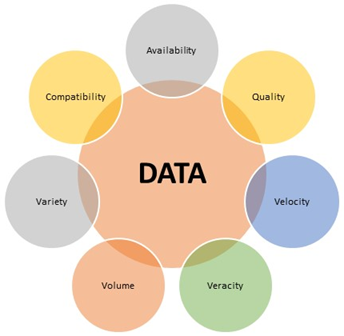
To calculate the lifetime validity of data, one must understand the four dimensions of data, commonly referred to as the 4V’s: Volume (Vo), Velocity (Ve), Variety (Va), and Veracity (Vr). The first three—Volume, Velocity, and Variety—are straightforward.
Dimension
Description
Volume (Vo)
The sheer amount/quantity of data from various sources. E.g., transactions, logs.
Velocity (Ve)
The speed at which data is generated and processed. Also known as the rate of data flow. E.g., real-time, batch.
Variety (Va)
The diverse forms/types of data. E.g., structured, semi-structured, and unstructured data.
Veracity (Vr)
The reliability and trustworthiness of data. E.g., accuracy, consistency, conformity.
Let’s focus on the fourth V, Veracity (Vr) which encompasses the accuracy and truthfulness aspects of data. Veracity is a function of four components that directly influence the insights and Business Value (Bv) generated.
This equation represents a more traditional view and emphasizes the fundamental aspects of data veracity: data quality, data value, data density, data volatility, and the impact of time. This equation is suitable for situations where the dataset is small and data volume, velocity, and variety are relatively stable or not significant factors. In short, the focus is on the intrinsic quality and reliability of the data.
The components explained:
Quality of Data (Dq): A normalized quantitative score, derived from a comprehensive data profiling process, serves as a measure of data quality (Dq). This score encapsulates the 4Cs: completeness, correctness, clarity, and consistency.
Data Volatility (Dvo): Refers to the duration for which the data or dataset remains relevant. It quantifies the spread and variability of data points, extending beyond mere temporal change. While some define volatility as the rate of data change, this definition emphasizes the overall fluctuation, i.e., rate at which data changes[1]. For example, customer preferences. A numerical scale, such as 1 to 10, can be used to represent the spectrum from low to high volatility.
Data Value (Dva): Represents the actionable insights, cost savings, or value of derived knowledge obtained through analytical modeling, such as correlation and regression. In essence, it answers the question, “What is the practical significance of this data analysis?” A numerical scale, such as 1 to 10, can be used to represent the range from low to high data value.
Quality of Data Density (Dd): Measures the concentration of valuable, complete, and relevant information within a dataset. It emphasizes the presence of meaningful data, rather than sheer volume. For example, a dataset with numerous entries but missing essential fields exhibits low data density quality. This assessment is determined through a combination of data profiling and subject matter expert (SME) evaluation.
Computing the lifetime value using Vr
All the above components are time-dependent, and any equation involving time will have an associated lifetime or value. Hence, the value of data either remains constant (for a period) or degrades over time, depending on the type of data. Now, let us integrate the 3Vs (Volume, Velocity and Variety) into this equation (Vr).
To briefly explain, data quality, value, and density are in the numerator because high values for these components improve data reliability. The other components negatively impact trustworthiness with higher values and are therefore in the denominator. To tailor the equation to specific use cases, weight coefficients can be incorporated to reflect the relative importance of each factor. These weights should be adjusted based on the unique context or requirements of the analysis. Generally, a lower overall score indicates that the data is aged, exhibits reduced stability, and/or possesses diminished reliability. This characteristic can be particularly valuable in scenarios where historical trends and patterns hold greater significance than contemporary data, such as retrospective studies or long-term trend analyses.
Real-world examples
Consider customer purchasing behavior data. Companies utilize segmentation and personalization based on customer lifecycle stages for targeted marketing. As individuals transition through life stages, their purchasing patterns evolve. Consequently, relying on data from a specific historical point—such as during a period of job searching, financial dependence, or early adulthood—to predict purchasing behavior during a later stage of financial independence, high-income employment, family life, or mid-adulthood is likely to produce inaccurate results.
Similarly, credit rating information demonstrates the impact of data aging. Financial institutions typically prioritize a customer’s recent credit history for risk assessment. A credit rating from an individual’s early adulthood is irrelevant for risk calculations in their mid-40s. These examples underscore the principle of data aging and its implications for analytical accuracy.
Strategies for mitigating the effects of data aging
Data Governance: Establishing clear data retention and data quality standards.
Data Versioning (by customer stages): Tracking changes to data over time to understand its evolution.
AI Infusion: Utilizing AI at every stage of the data lifecycle to identify and address data anomalies, inconsistencies and data decay.
Conclusion
The truth is, data isn’t static. It’s a living, breathing entity that changes over time. Recognizing and adapting to these changes is what separates effective data strategies from those that quickly become obsolete. If you found this post insightful, please comment below! In a future post, I will explore the impact of other components like data gravity and data visualization on business value. Let me know if that’s something you’d like to see!
Reference:
“The Importance of Data Quality in a Data-Driven World” by Gartner (2023)
“Data Decay: Why Your Data Isn’t as Good as You Think It Is” by Forbes (2022)
McKinsey & Company, “The Age of Analytics: Competing in a Data-Driven World” (2023)
Deloitte Insights, “Data Valuation: Understanding the Value of Your Data Assets” (2022)
[1] “rate of change of data” is typically represented as a derivative in mathematics. It gives a precise value showing how one variable changes in relation to another (e.g., how temperature changes with time). “rate at which data changes” emphasizes the speed or pace at which the data is changing over time (pace of data variation).
To keep pace with ever-present business and technology change and challenges, organizations need operating models built with a strong data and analytics foundation. Here’s how your organization can build one incorporating a range of key components and best practices to quickly realize your business objectives.
Executive Summary
To succeed in today’s hypercompetitive global economy, organizations must embrace insight-driven decision-making. This enables them to quickly anticipate and enforce business change with constant and effective innovation that swiftly incorporates technological advances where appropriate. The pivot to digital, consumer-minded new regulations around data privacy and the compelling need for greater levels of data quality together are forcing organizations to enact better controls over how data is created, transformed, stored and consumed across the extended enterprise. Chief data/analytics officers who are directly responsible for the sanctity and security of enterprise data are struggling to bridge the gap between their data strategies, day-to-day operations and core processes. This is where an operating model can help. It provides a common view/definition of how an organization should operate to convert its business strategy to operational design. While some mature organizations in heavily regulated sectors (e.g., financial services), and fast-paced sectors (e.g., retail) are tweaking their existing operating models, younger organizations are creating operating models with data and analytics as the backbone to meet their business objectives. This white paper provides a framework along with a set of must-have components for building a data and analytics operating model (or customizing an existing model).
The starting point: Methodology
Each organization is unique, with its own specific data and analytics needs. Different sets of capabilities are often required to fill these needs. For this reason, creating an operating model blueprint is an art, and is no trivial matter. The following systematic approach to building it will ensure the final product works optimally for your organization. Building the operating model is a three-step process starting with the business model (focus on data) followed by operating model design and then architecture. However, there is a precursory step, called “the pivots,” to capture the current state and extract data points from the business model prior to designing the data and analytics operating model. Understanding key elements that can influence the overall operating model is therefore an important consideration from the get-go (as Figure 1 illustrates). The operating model design focuses on integration and standardization, while the operating model architecture provides a detailed but still abstract view of organizing logic for business, data and technology. In simple terms, this pertains to the crystallization of the design approach for various components, including the interaction model and process optimization.
Preliminary step: The pivots
No two organizations are identical, and the operating model can differ based on a number of parameters — or pivots — that influence the operating model design. These parameters fall into three broad buckets:
Design principles: These set the foundation for target state definition, operation and implementation. Creating a data vision statement, therefore, will have a direct impact on the model’s design principles. Keep in mind, effective design principles will leverage all existing organizational capabilities and resources to the extent possible. In addition, they will be reusable despite disruptive technologies and industrial advancements. So these principles should not contain any generic statements, like “enable better visualization,” that are difficult to measure or so particular to your organization that operating-model evaluation is contingent upon them. The principles can address areas such as efficiency, cost, satisfaction, governance, technology, performance metrics, etc.
Sequence of operating model development
Current state: Gauging the maturity of data and related components — which is vital to designing the right model — demands a two-pronged approach: top down and bottom up. The reason? Findings will reveal key levers that require attention and a round of prioritization, which in turn can move decision-makers to see if intermediate operating models (IOMs) are required.
Influencers: Influencers fall into three broad categories: internal, external and support. Current-state assessment captures these details, requiring team leaders to be cognizant of these parameters prior to the operating-model design (see Figure 2). The “internal” category captures detail at the organization level. ”External” highlights the organization’s focus and factors that can affect the organization. And “support factor” provides insights into how much complexity and effort will be required by the transformation exercise.
Operating model influencers
First step: Business model
A business model describes how an enterprise leverages its products/services to deliver value, as well as generate revenue and profit. Unlike a corporate business model, however, the objective here is to identify all core processes that generate data. In addition, the business model needs to capture all details from a data lens — anything that generates or touches data across the entire data value chain (see Figure 3). We recommend that organizations leverage one or more of the popular strategy frameworks, such as the Business Model Canvas1 or the Operating Model Canvas,2 to convert the information gathered as part of the pivots into a business model. Other frameworks that add value are Porter’s Value Chain3 and McKinsey’s 7S framework.4 The output of this step is not a literal model but a collection of data points from the corporate business model and current state required to build the operating model.
Second step: Operating model
The operating model is an extension of the business model. It addresses how people, process and technology elements are integrated and standardized.
Integration: This is the most difficult part, as it connects various business units including third parties. The integration of data is primarily at the process level (both between and across processes) to enable end-to-end transaction processing and a 360-degree view of the customer. The objective is to identify the core processes and determine the level/type of integration required for end-to-end functioning to enable increased efficiency, coordination, transparency and agility (see Figure 4). A good starting point is to create a cross-functional process map, enterprise bus matrix, activity based map or competency map to understand the complexity of core processes and data. In our experience, tight integration between processes and functions can enable various functionalities like self-service, process automation, data consolidation, etc.
The data value chain
Standardization: During process execution, data is being generated. Standardization ensures the data is consistent (e.g., format), no matter where (the system), who (the trigger), what (the process) or how (data generation process) within the enterprise. Determine what elements in each process need standardization and the extent required. Higher levels of standardization can lead to higher costs and lower flexibility, so striking a balance is key.
Integration & standardization
Creating a reference data & analytics operating model
The reference operating model (see Figure 5) is customizable, but will remain largely intact at this level. As the nine components are detailed, the model will change substantially. It is common to see three to four iterations before the model is elaborate enough for execution.
For anyone looking to design a data and analytics operating model, Figure 5 is an excellent starting point as it has all the key components and areas.
Final step: Operating model architecture
Diverse stakeholders often require different views of the operating model for different reasons. As there is no one “correct” view of the operating model, organizations may need to create variants to fulfill everyone’s needs. A good example is comparing what a CEO will look for (e.g., strategic insights) versus what a CIO or COO would look for (e.g., an operating model architecture). To accommodate these variations, modeling tools like Archimate5 will help create those different views quickly. Since the architecture can include many objects and relations over time, such tools will help greatly in maintaining the operating model. The objective is to blend process and technology to achieve the end objective. This means using documentation of operational processes aligned to industry best practices like Six Sigma, ITIL, CMM, etc. for functional areas. At this stage it is also necessary to define the optimal staffing model with the right skill sets. In addition, we take a closer look at what the organization has and what it needs, always keeping value and efficiency as the primary goal. Striking the right balance is key as it can become expensive to attain even a small return on investment. Each of the core components in Figure 5 needs to be detailed at this point, in the form of a checklist, template, process, RACIF, performance metrics, etc. as applicable – the detailing of three subcomponents one level down. Subsequent levels involve detailing each block in Figure 6 until task/activity level granularity is reached.
Reference data & analytics operating model (Level 1)
The operating model components
The nine components shown in Figure 5 will be present in one form or another, regardless of the industry or the organization of business units. Like any other operating model, the data and analytics model also involves people, process and technology, but from a data lens.
Component 1: Manage process: If an enterprise-level business operating model exists, this component would act as the connector/ Component 1: Manage Process: If an enterpriselevel business operating model exists, this component would act as the connector/bridge between the data world and the business world. Every business unit has a set of core processes that generate data through various channels. Operational efficiency and the enablement of capabilities depend on the end-to-end management and control of these processes. For example, the quality of data and reporting capability depends on the extent of coupling between the processes.
Component 2: Manage demand/requirements & manage channel: Business units are normally thirsty for insights and require different types of data from time to time. Effectively managing these demands through a formal prioritization process is mandatory to avoid duplication of effort, enable faster turnaround and direct dollars to the right initiative.
Sampling of subcomponents: An illustrative view
Component 3: Manage data: This component manages and controls the data generated by the processes from cradle to grave. In other words, the processes, procedures, controls and standards around data, required to source, store, synthesize, integrate, secure, model and report it. The complexity of this component depends on the existing technology landscape and the three v’s of data: volume, velocity and variety. For a fairly centralized or single stack setup with a limited number of complementary tools and technology proliferation, this is straightforward. For many organizations, the people and process elements can become costly and time-consuming to build.
To enable certain advanced capabilities, the architect’s design and detail are major parts of this component. Each of the five subcomponents requires a good deal of due diligence in subsequent levels, especially to enable “as-aservice” and “self-service” capabilities.
Component 4a: Data management services: Data management is a broad area, and each subcomponent is unique. Given exponential data growth and use cases around data, the ability to independently trigger and manage each of the subcomponents is vital. Hence, enabling each subcomponent as a service adds value. While detailing the subcomponents, architects get involved to ensure the process can handle all types of data and scenarios. Each of the subcomponents will have its set of policy, process, controls, frameworks, service catalog and technology components.
Enablement of some of the capabilities as a service and the extent to which it can operate depends on the design of Component 3. It is common to see a few IOMs in place before the subcomponents mature.
Component 4b: Data analytics services: Deriving trustable insights from data captured across the organization is not easy. Every organization and business unit has its requirement and priority. Hence, there is no one-size-fits-all method. In addition, with advanced analytics such as those built around machine-learning (ML) algorithms, natural language processing (NLP) and other forms of artificial intelligence (AI), a standard model is not possible. Prior to detailing this component, it is mandatory to understand clearly what the business wants and how your team intends to deliver it. Broadly, the technology stack and data foundation determine the delivery method and extent of as-a-service capabilities.
Similar to Component 4a, IOMs help achieve the end goal in a controlled manner. The interaction model will focus more on how the analytics team will work with the business to find, analyze and capture use cases/requirements from the industry and business units. The decision on the setup — centralized vs. federated — will influence the design of subcomponents.
Business units are normally thirsty for insights and require different types of data from time to time. Effectively managing these demands through a formal prioritization process is mandatory to avoid duplication of effort, enable faster turnaround and direct dollars to the right initiative.
Component 5: Manage project lifecycle: The project lifecycle component accommodates projects of Waterfall, Agile and/or hybrid nature. Figure 5 depicts a standard project lifecycle process. However, this is customizable or replaceable with your organization’s existing model. In all scenarios, the components require detailing from a data standpoint. Organizations that have an existing program management office (PMO) can leverage what they already have (e.g., prioritization, checklist, etc.) and supplement the remaining requirements.
The interaction model design will help support servicing of as-a-service and on-demand data requests from the data and analytics side during the regular program/project lifecycle.
Component 6: Manage technology/ platform: This component, which addresses the technology elements, includes IT services such as shared services, security, privacy and risk, architecture, infrastructure, data center and applications (web, mobile, on-premises).
As in the previous component, it is crucial to detail the interaction model with respect to how IT should operate in order to support the as-aservice and/or self-service models. For example, this should include cadence for communication between various teams within IT, handling of live projects, issues handling, etc.
Component 7: Manage support: No matter how well the operating model is designed, the human dimension plays a crucial role, too. Be it business, IT or corporate function, individuals’ buy-in and involvement can make or break the operating model.
The typical support groups involved in the operating-model effort include BA team (business technology), PMO, architecture board/group, change management/advisory training and release management teams, the infrastructure support group, IT applications team and corporate support group (HR, finance, etc.). Organization change management (OCM) is a critical but often overlooked component. Without it, the entire transformation exercise can fail.
Component 8: Manage change: This component complements the support component by providing the processes, controls and procedures required to manage and sustain the setup from a data perspective. This component manages both data change management and OCM. Tight integration between this and all the other components is key. Failure to define these interaction models will result in limited scalability, flexibility and robustness to accommodate change.
The detailing of this component will determine the ease of transitioning from an existing operating model to a new operating model (transformation) or of bringing additions to the existing operating model (enhancement).
Component 9: Manage governance: Governance ties all the components together, and thus is responsible for achieving the synergies needed for operational excellence. Think of it as the carriage driver that steers the horses. Although each component is capable of functioning without governance, over time they can become unmanageable and fail. Hence, planning and building governance into the DNA of the operating model adds value.
The typical governance areas to be detailed include data/information governance framework, charter, policy, process, controls standards, and the architecture to support enterprise data governance
Intermediate operating models (IOMs)
As mentioned above, an organization can create as many IOMs as it needs to achieve its end objectives. Though there is no one right answer to the question of optimal number of IOMs, it is better to have no more than two IOMs in a span of one year, to give sufficient time for model stabilization and adoption. The key factors that influence IOMs are budget, regulatory pressure, industrial and technology disruptions, and the organization’s risk appetite. The biggest benefit of IOMs lies in their phased approach, which helps balance short-term priorities, manage risks associated with large transformations and satisfy the expectation of top management to see tangible benefits at regular intervals for every dollar spent.
IOMs help achieve the end goal in a controlled manner. The interaction model will focus more on how the analytics team will work with the business to find, analyze and capture use cases/ requirements from the industry and business units. The decision on the setup – centralized vs. federated – will influence the design of subcomponents.
DAOM (Level 2)
To succeed with IOMs, organizations need a tested approach that includes the following critical success factors:
Clear vision around data and analytics.
Understanding of the problems faced by customers, vendors/suppliers and employees.
Careful attention paid to influencers.
Trusted facts and numbers for insights and interpretation.
Understanding that the organization cannot cover all aspects (in breadth) on the first attempt.
Avoidance of emotional attachment to the process, or of being too detail-oriented.
Avoidance of trying to design an operating model optimized for everything.
Avoidance of passive governance — as achieving active governance is the goal.
Methodology: The big picture view
Moving forward
Two factors deserve highlighting: First, as organizations establish new business ventures and models to support their go-to-market strategies, their operating models may also require changes. However, a well-designed operating model will be adaptive enough to new developments that it should not change frequently. Second, the data-to-insight lifecycle is a very complex and sophisticated process given the constantly changing ways of collecting and processing data. Furthermore, at a time when complex data ecosystems are rapidly evolving and organizations are hungry to use all available data for competitive advantage, enabling things such as data monetization and insight-driven decisionmaking becomes a daunting task. This is where a robust data and analytics operating model shines. According to a McKinsey Global Institute report, “The biggest barriers companies face in extracting value from data and analytics are organizational.”6 Hence, organizations must prioritize and focus on people and processes as much as on technological aspects. Just spending heavily on the latest technologies to build data and analytics capabilities will not help, as it will lead to chaos, inefficiencies and poor adoption. Though there is no one-sizefits-all approach, the material above provides key principles that, when adopted, can provide optimal outcomes for increased agility, better operational efficiency and smoother transitions.
Endnotes
1 A tool that allows one to describe, design, challenge and pivot the business model in a straightforward, structured way. Created by Alexander Osterwalder, of Strategyzer. 2 Operating model canvas helps to capture thoughts about how to design operations and organizations that will deliver a value proposition to a target customer or beneficiary. It helps translate strategy into choices about operations and organizations. Created by Andrew Campbell, Mikel Gutierrez and Mark Lancelott. 3 First described by Michael E. Porter in his 1985 best-seller, Competitive Advantage: Creating and Sustaining Superior Performance. This is a general-purpose value chain to help organizations understand their own sources of value — i.e., the set of activities that helps an organization to generate value for its customers. 4 The 7S framework is based on the theory that for an organization to perform well, the seven elements (structure, strategy, systems, skills, style, staff and shared values) need to be aligned and mutually reinforcing. The model helps identify what needs to be realigned to improve performance and/or to maintain alignment. 5 ArchiMate is a technical standard from The Open Group and is based on the concepts of the IEEE 1471 standard. This is an open and independent enterprise architecture modeling language. For more information: www.opengroup.org/subjectareas/enterprise/archimate-overview. 6 The age of analytics: Competing in a data-driven world. Retrieved from www.mckinsey.com/~/media/McKinsey/Business%20Functions/McKinsey%20Analytics/Our%20Insights/The%20age%20of%20analytics%20Competing%20in%20a%20data%20driven%20world/MGI-The-Age-of-Analytics-Full-report.ashx
How many times have we gone through the routine of seeing data issue after data issue when something goes live in production, no matter how much of due-diligence was put in place? Despite having industry leading frameworks, operating models, air-tight processes, best-in-class templates, data issues creep in at multiple touch-points. Based on my assessment of UAT/post Go-Live scenario at various clients, more than 60% of the issues faced is related to data. Some of the organizations assessed had some sort of a piecemeal approach (or a quick fix in their parlance) to reduce data issues but it was more reactive and not sufficient, foolproof, scalable and/or repeatable.
The project types assessed include data migration, data integration, data transformation and creating/enhancing a bunch of analytical reports. In all the scenarios, data issue topped the charts as the number one pain area to be addressed. This is because the “data” aspect was either overlooked or not given the required level of importance. None of the processes were designed keeping data as the core/foundation. Everyone understands that data is an asset, yet no one has designed the frameworks models and processes keeping data as the key focus. It is just one module or component in the entire spectrum of things. Addressing all aspects around data in a systematic manner in addition to the existing parameters is key to reducing data issues.
Figure: 1 – Key areas around data
Figure 1 shows some of the key areas that need to be addressed around data as a bare minimum to reduce data related issues.
A conceptual “Data Readiness” framework that can be customized and scaled up as required to suit various project types is shown here. Conducting an end-to-end data readiness check using such a well-defined framework, covering all major touch-points for data will help address data related issues early. While this framework is predominantly helpful during the approval/kick-off phase of projects, it extends all the way till the project goes live and declared stable.
Figure: 2 – Base framework for Data readiness
This highly scalable and customizable framework comes with supporting artifact(s) for each area as applicable. Refer Figure 3 for details. These artifacts are spread across people, process and technology areas. This will automatically address issues like schedule overruns, cost overruns, rework, low user confidence on IT, etc. as it touches upon all the aspects related to data.
The biggest advantage of this framework is that it can be easily blended with any existing governance model and PMO model an organization might be following.
The WOW factor – Find that one thing that will create the wow factor for your client and consider half the engagement done. Unfortunately this at times strikes a day before the final presentation, but trust me the one night left in your hand is more than sufficient to do wonders.
See through your clients’ eye – The key things required to find this wow factor is the ability to see the vision of your client. Feel their problem. Understand their priorities and decrypt what they are not able to explain in words.
Power of Analogy – Use a simple analogy to restate the clients’ true problem. Use the same or another simple analogy to explain the solution. I normally take the example of food (if I am hungry) or a completely different industry or topic like cars or gadgets depending on the circumstance.
Let the numbers speak – When you know you are with a tough client, it’s always safe to let the numbers speak. Quantify everything in the simplest and most logical way possible. Include as many stakeholders as required into the equation to remove anomalies and there you have a nice little shield to defend yourself.
The animated story – The term ‘animation’ here stands for the visualizations. We all know the attention span and time from a CxO is highly limited. Everyone is looking for innovation and simplicity. With prescriptive and cognitive analytics gaining popularity, it is necessary to let the charts and pictures form the core of your presentation, while having a nice story crafted around this core. Some consultants would call this gift wrapping. Also make sure your presentation can tell the story you intended all by itself, as that is the cherry on the cake.
Know not just thy client but also their industry – If your client is a consulting firm, the amount of content you stuff in a slide does not matter, attention to detail does. Get all your facts triple checked! It will only take 6 seconds for them to process the entire slide and rip you apart. The first question is most likely, “what do you mean by that statement” or “where did you get that number from?”
If it is a financial client, make sure you are careful with the usage of red color. And do have a lot of charts backed by numbers. It only takes a few seconds to process this kind of content for them. On the other hand, if your client is in the Consumer Goods or Retail segment, use icons, cartoons and animations. It keeps them glued to your presentation and helps them digest the content faster and better.
I still have not figured out if region has an impact but culture definitely has. This is from my experience talking to a client in Thailand, Jakarta and Malaysia.
Sell the solution to your team first – the best way to test the solution you have built is to try selling it to your own team. No matter how much time and effort you put in, give an ear to your team members (especially the junior most staff as the most abstract and raw thinking comes from them). No consensus with your team is as good as you are a dead man even before the battle starts.
The selling of assets, divisions, or subsidiaries to another corporation or individual(s) is termed divestiture. According to a divestiture survey conducted by Deloitte, “the top reason for divesting a business unit or segment is that it is not considered core to the company’s business strategy” and “the need to get rid of non-core assets or financing needs as their top reason for divesting an asset”. In some cases, divestiture is done to de-risk the parent company from a high-potential but risky business line or product line. Economic turnaround and a wall of capital also drive the demand for divestitures.
Divestitures have some unique characteristics that distinguish them from other M&A transactions and spin-offs. For example, the need to separate (aka disentangle) business and technology assets of the unit being sold from that of the seller before the sale is executed. Performing the disentanglement under tighter time constraints, i.e. before the close of the transaction, unlike in the case of an acquisition scenario adds to the complexity.
The critical aspect of the entire process is data disposition. Though similar technologies could have been deployed on the buyer and seller side, the handover can end up painful if a formal process is not adopted right from the due-diligence phase. This is because, in the case of divestiture, the process is not as simple as a ‘lift-shift and operate’ process. There is a hand full of frameworks available in the market detailing the overall process in a divestiture scenario nevertheless the core component which is “data” is touched upon at the surface level and not expanded enough to throw light on the true complexities involved.
What does the trend indicate?
Divestitures and carve-outs are very common in Life Science, Retail and Manufacturing.
If we observe the economic movements and divestiture trend over the past decade, it is clear that the economic conditions have a direct correlation and significant impact on divestiture. So organizations have to proactively start assessing their assets at least annually to understand which assets are potential candidates for divestitures and prepare for the same. This way, when the time is right the organization would be well prepared for the transition services agreement (TSA) phase.
The bottom-line
Overall planning is a critical success factor, however, that process not involving sufficient planning around the “data” component can result in surprises at various points during the course of divestiture and even end up in breaking the deal. End of the day the shareholders and top management will only look at the data to say if the deal was successful or not.
Faster due-diligence, quicker integration, and visible tracking of key metrics/milestones from the start is what one looks for. As per industry experts, having a proactive approach in place has helped sellers to increase the valuation of the deal.
One of the key outputs of this framework is a customized technology and data roadmap. This roadmap will contain recommendations and details around the data and technology complexities that need to be addressed prior to, during, and post the divestiture to ensure a higher success rate for both the selling and buying organization.
The Divestiture Model – Buyer and Seller Perspective
Broadly the Divestiture model has three components: Core, Buyer, and Seller:
Core component: Handles all activities related to overall due-diligence related to data such as identifying data owners and stewards, data disposition strategy, value creation opportunity (VCO), and enterprise-level data integration with core applications at the buyer and seller end.
Seller component: Focuses on seller side activities related to data like data inventory, business metadata documentation, data lineage/dependency, business process, data flow/process flow diagrams and level of integration with enterprise apps, business impact on existing processes, and resource movement (technology and people).
Buyer component: Focuses on buyer-side activities related to data like data mapping, data integration, data quality, technology, capacity planning, and business process alignment.
Governance: The entire process is governed by a 360-degree data/information governance framework to maintain the privacy, security, regulatory, and integrity aspects of data between the two organizations.
Divestiture model – The Core
Addressing the “data” component:
Selling Organization
Only a few sellers understand the fact that just getting a deal signed and closed isn’t always the end. From a pre-divestiture perspective, the organization should have a well-defined process for possible carve-outs, a good data inventory with documented business metadata, documented business processes around the non-performing assets, and a clear data lineage and impact document. Armed with this information, the selling organization can get into any kind of TSA comfortably and answer most of the questions the buyer will raise during their due-diligence.
From a post-divestiture perspective, the selling organization needs to assess what technologies and processes need to be tweaked or decoupled to achieve the company’s post-divestiture strategy. A plan to minimize the impact of operational dependencies on existing systems and processes with enterprise applications like ERP when the data stops coming in. If this was not done thoroughly and analyzed well in advance, it can have a crippling effect on the entire organization. A typical mistake committed by the selling organization is, just looking at the cost savings due to alignment/rationalization of infrastructure and missing the intricate coupling the data has at the enterprise level.
Having a divestiture strategy with data as the core of the framework can address a host of issues for the selling organization and speed up the pace of transactions.
Buying Organization
There could be two potential scenarios when it comes to the buying organization. Either the organization already has the product line or business unit and is looking to enhance its position in the market or the organization is extending itself into a new line of business with no past hands-on experience. In the case of the former, the complexities can be primarily attributed to migration and merging of data between the two organizations. Questions like what data to keep/pull, what technology to use, what data requires cleansing, similarities in processes, capacity planning to house the new data, what tweaks will be required to existing reports, the new reports that need to be created, to show the benefit of the buy to shareholders, etc. arise.
The pre-divestiture stage will address most of the questions raised above and based on the parameters a strategy is drawn for data disposition. During the divestiture stage, when the data disposition is actually happening, new reports, scorecards, and dashboards are built to ensure complete visibility across the organization at every stage of the divestiture process.
In the latter case where the organization is extending itself into a new line of business, questions like should a lift and shift strategy be adopted or should just the key data be brought in, or should it be a start from a clean state, etc. arise. There is no one correct answer for this as it depends on the quality of processes, technology adopted and data coming from the selling organization.
Divestiture Data Framework
The Divestiture Data Framework was designed to highlight the importance of the core component which is “data”.
Divestiture Data Framework
One of the key outputs of this framework is a customized technology and data roadmap. The roadmap will contain recommendations and details around both data and technology complexities that need to be addressed prior to, during, and post the divestiture to ensure a higher success rate for both the selling and buying organization.
Caveat: This post is only to educate the people on the quality, standard of processes and customer care one can expect with Standard Chartered Bank (SCB) in India. This post in no way is aimed at driving the existing customers or potential customers away from having a relationship with SCB. Everything stated in this post is backed by various reference numbers that could be verified with SCB and purely based on my experience.
Background:
Relationship with SCB: January 2013 to February 2014
Purpose: Home Loan
Time taken to close home loan: 27th November, 2013 to 6th February, 2014
No. of reference numbers/complaints/callback requests raised: 18+
No. of calls to SCB customer care: 35+ calls covering over 270+ minutes in just over 2 months
This post is divided into sections detailing what one can expect at various stages of interaction with SCB. Though the relationship with SCB started with the purpose of having a home loan, I was also sold a top-up loan under the name of liability insurance and a SCB “Preferred Banking” credit card.
Reason for closure of loan – Sudden surge in Interest rate!
SCB raised my interest rate directly from 10.15% to 10.9% while every other bank including HDFC and ICICI was way below this number. When asked to reconsider my interest rate, they gave me 10.39% (same rate offered to customers taking new loans) provided I pay about 11K as processing fee. Points to note:
This processing fee comes at a time when RBI is working on removing it completely and other banks are waiving off quoting an offer or some such thing
If you do the math to breakeven (assuming you paid the 11K processing fee), you will need an absolute minimum of 6 months in the case of my loan
Not sure if SCB thinks that its customers are mostly dumb or too rich and that they can get away with these things.
Sales Team:
The sales person like in any other private bank was good in selling their products. They also make verbal promises. As a customer or potential customer, what you should be aware:
Get everything in written or mailed to you from their official mail ID
Without this anything you say at the branch or to their call center team has no validity and will not be entertained
Proof: A verbal promise that pre-payment cheques will be collected from you at your office or residence is possible only with that letter. When the time came and I reached out to them, the response was, “Sir, you need to go to the branch and give the cheque. There is a form you need to fill.” When asked about the promise of having them collected and so on, “Sorry sir, you will have to go to the Koramangala branch only.” Sales staffs name: Bharathi.
Get the process for closure of loan or any service you want clearly explained and documented (specific to your loan/request)
Without this be ready for surprises in terms of last-minute delays, new processes being explained from time-to-time, etc.
This applies mostly around the time when they try to up-sell and cross-sell. Example: credit card and insurance
It is common to hear about new policies and/or charges introduced by SCB just about the time when you thought everything is done
Do not let the sales person force you to take a liability insurance and treat it as a Top-up loan
Liability insurance (sold by their staff Pankaj) being treated as a top-up loan is good for the agent as it helps them meet their targets. However, this leads to complications when it comes to closing of loan
Though you were told it is only liability insurance, you the customer should know that the sales person treated it as a top-up loan and complicated things. Now you have actually got two loans in hand
Assurance that they will help you at the time of closing the loan is no use as when you call them, they will tell you to call the customer care and follow it up with them
Showing liability insurance as a top-up loan and tying it to the primary home loan, will now need you, the customer to be cautious and closing each one of them manually by raising a request
SCB systems are not advanced enough to show all the details on the customer care reps. Screen so it is “always” your fault and not the banks fault
Registration amount must be clarified before going to sub-registrar’s office
This is the first bank where the bank tells the customer how to do fraud and save money
Proof: During registration of my property at sub-registrars’ office, the sales person had already assumed that I will register the property at a lower rate (not at the actual rate I bought the property at) and prepared the documents accordingly. In addition, all documents related to the loan were dispatched to SCBs Central Processing Unit in Chennai. Now I was being told by the agent to go ahead with the registration at a lower rate as it is beneficial to me (in terms of saving money). When I insisted on registering the property at the actual rate I bought, I was told it is not possible to bring the documents back from Chennai. We had to request them to connect us to the regional manager so we can escalate and only then did they bring the documents back and register the property at actual rate
At the branch:
During my handful of visits to the Koramangala branch in Bangalore, I observed that only two service desks will be open at any instant of time to handle all kinds of requests. Even if there are 10 customers waiting to be served, and other staffs are either freely roaming around or sitting in their cabins, no extra counter will be opened.
SCB Systems & Process Quality:
SCB systems seem to be a little primitive as most of the time you will hear the customer care say that they need a minute to pull up your details on their screen as the system is slow or they need to transfer the call to someone else as their system hanged
Proof: Please ask SCB to give all call transcripts and you can confirm this
SCB systems cannot show all details related to a customer
Proof: Even after closing of my credit card, and informing the representatives that I no longer hold a SCB card, offers like a pre-approved loan on the SCB credit card issued to me were being repeated by the customer care
When a request is made to the customer care team to close a loan, you have to explicitly specify each loan number. Mentioning the primary loan account and informing the customer rep. to close everything related to it will not help. Informing that you will ultimately need the original documents back and they need to do everything related to the closing of loan will also not help. This is because the system does not show the same
Proof: Even at the branch, when I gave the final cheque and asked whether everything is done from my end and I will get the original documents, the person at the branch checked his screen and confirmed, “Yes Sir. It’s all done. You will get an SMS within 7 working days. Once you get that, you can fix an appointment and collect the docs.”
Managing of workflows in SCB is a manual process
Proof: When a staff says, “they are marking your case on priority” it only means they wrote down, “high priority” in notes and the respective teams has to manually look into it. This is one of the reasons why I had to raise many complaint requests after SLA expired
Proof: If the EMI date falls close to the date in PTQ (Pre-closure letter), rest assured your wait is going to be longer. The team does not like to manually intervene and stop the EMI or change the workflow to have things processed fast
Courier of documents from Chennai to Bangalore can take up to 15 working days
Normal process: You will get an SMS once the documents have been dispatched from Chennai. This SMS will say you can call the branch and take an appointment to collect the docs. As per the SMS when you call, you will be given a date that is 3 days from the date of your call to collect documents
Your bad luck process: SMS will say you can call the branch and take an appointment to collect the docs. As per the SMS when you call, if the customer rep does not know about this three-day thing he/she will tell you to call after 3 days and book an appointment. When you do so after 3 working days, the customer rep who might have a slightly better experience than the previous rep you spoke to, will say, “Sir, you can only get an appointment after 3 working days!” This is how SCB drives you nuts!
Retention Team:
If the amount of loan for closure is high (not sure what is high for SCB) or low (25K for my liability insurance), the request will be kept on hold for a longer time before approval.
Even for the closure of liability insurance (top-up loan), the retention team has to approve
Even if you are ready to continue the liability insurance with SCB, their process says I cannot if I want the original documents linked to the primary loan
The above is a good example to show how their systems are designed to drive customers away. I had to pay a small penalty on the liability insurance because of SCBs great process. Wish I can go to the court and make SCB pay the penalty for their pathetic systems and processes.
Customer Care:
The team will often use these lines:
“I am marking your case to be taken on Priority”
“By End of day, we will get back to you”
“I will personally follow up and get back to you by tomorrow”.
Now here is the funny part, one day I asked them what is EOD for SCB? Is it 4pm, 5pm? And they had absolutely no clue what End of day is. They are just told to say, “End of day”. If you call after 6pm, they will tell you, “…everyone has left for the day and someone will get back to you by tomorrow positively”.
Only way to make them call you is to place a call back request and hope to get a call back the following day. Note: If you do not get a callback within 24hrs and you call the customer care, the call back request will be treated as complete and will be closed
Proof: My conversation with Moni in Escalations team is proof of the same. She was hell-bent on closing a callback request whose SLA was expiring their “EOD”. No request to keep the callback request open will be entertained. You can call the team after sometime and be rest assured that the call back request was closed
The team has the freedom to raise as many tickets (Reference numbers) as they please. This is because every ticket they give you buys them time
Proof: Number of requests I have raised in the just 2 months
Toll free number will connect you randomly to either their Chennai office or the Bangalore office based on availability. So a promise made by a floor manager/supervisor/team lead in one office cannot be followed by his/her counterpart in another office. There is no facility to route the call to the other office or get information for you. You the customer has to place a call back request and wait 24 hours for a reply.
Other option is to keep calling or keep your fingers crossed to get connected to the branch you want and hope the person is in office. Some people like supervisor, Mr. Manjunath comes to office only at 12 noon (he himself said this) and will not be available after 6pm
Any promise of personal follow-up from SCB is useless as you still have to call them and remind them
Proof: My interaction with Mr. Manjunath R and Miss. Arthy Jaganathan
Credit card:
This is one of the most notorious cards I have seen till date.
Ensure the free credit card given to you is used at least 4 times within the first 3 months period or so. Else you will be levied a charge of Rs.250/- for non-usage
Want to talk to their customer care more than two times in a month? Be ready to flush Rs.50/- per call from the 3rd call you make
Redeem all your points – get the gifts – wait for the statement to get generated – pay the outstanding amount and place a request for closure of card. Theoretically, after 7 working days, the card is closed. But SCBs systems are so good, that the redemption fee of Rs. 111.24/- can appear after 2 months. Now that your card is closed, the only way to make the payment is, you the customer must take the pain of either going to the bank or an ATM with a cheque. Wow!
By the way, when asked about this to the customer care, they do not accept it is their fault, they still hold you responsible. If this amount came up after 6 months, you still owe the bank. The bank is not responsible for you having closed the card long back
CEO’s office:
I was so pissed off with the customer care team that I decided to let the CEO India & South Asia Operations, Mr. Sunil Kaushal know about the service quality so others don’t have to suffer like me. Guess what!
Not even a courtesy acknowledgement mail from CEOs office. Nice email etiquette for a British multinational banking and financial services company
First time I mailed about the quality of loan process, second time it was about the quality of credit card process. In this mail, I requested indirectly for a courtesy acknowledgement. So the mail was forwarded to the same team I was interacting with and they acknowledged receiving the mail
Conclusion:
If you choose SCB, be ready to face some or all of this. If you found reading this long post was pain, you can understand how much pain I was put through by this bank in just 2 months.
***Will post the typical process flow for loan closure in SCB shortly.